5 Paths to Review Before Choosing an Energy Infusion
Review five safe decision paths for low energy, including emergency care, clinical assessment, basics, cause-specific care and clinician-screened infusion review.
By Pure Drip
Conservative health-information guide
5 Paths to Review Before Choosing an Energy Infusion
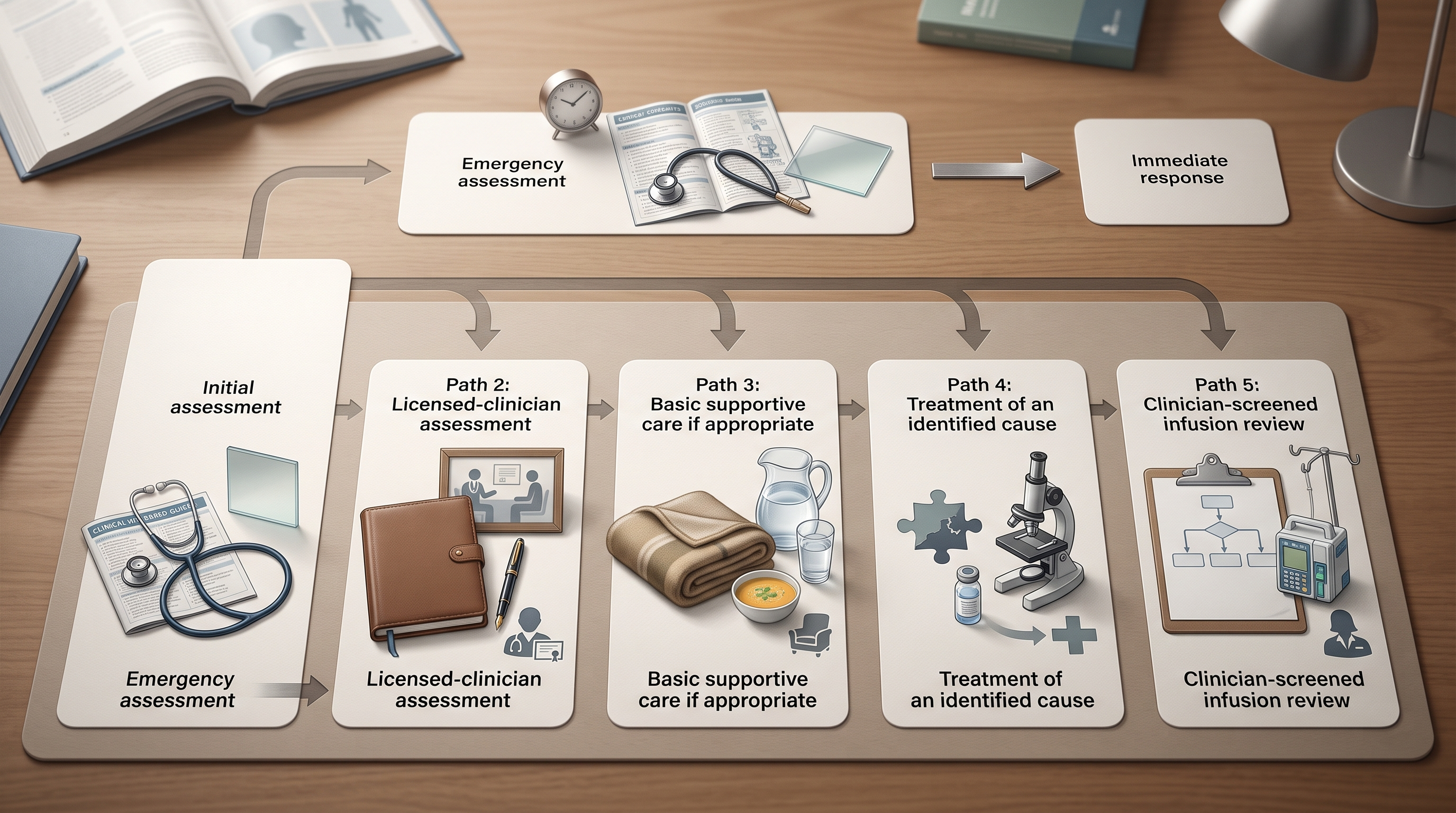
Short answer: “low energy” is a symptom, not a diagnosis or an IV ingredient list. Review five paths in order: emergency assessment for red flags, licensed-clinician assessment for new or persistent symptoms, basic sleep/nutrition/oral-fluid support when appropriate, treatment of an identified cause, and only then a clinician-controlled infusion discussion if medically indicated. No branded “energy” infusion should bypass history, medication, allergy, product, consent and monitoring checks.
Medical disclaimer: this article is general information, not diagnosis, treatment advice or an endorsement of IV therapy. A licensed clinician who knows your history must determine what assessment or treatment is appropriate.
Path 1 Get emergency assessment for red flags
Do not book an elective wellness service for severe or rapidly worsening symptoms. Call 911 or local emergency services for trouble breathing or severe shortness of breath, persistent pressure or pain in the chest, new confusion, difficulty waking or staying awake, or pale, grey or blue-coloured skin, lips or nail beds. The Public Health Agency of Canada lists these as severe symptoms requiring emergency help.
Fainting, severe weakness, sudden neurologic symptoms, uncontrolled bleeding, a serious allergic reaction or another perceived emergency also needs urgent assessment. Do not drive yourself when it is unsafe. An elective infusion setting should never be described as an alternative to emergency diagnosis and treatment.
Who this path fits: anyone with severe, sudden, worsening or alarming symptoms. Stop condition: do not continue shopping for an “energy” option.
Path 2 Arrange a licensed-clinician assessment
New, persistent, recurrent or unexplained low energy can have many causes. A clinician may ask about onset, sleep, food and fluids, illness, bleeding, pain, mood, pregnancy, medications, substances, activity, work pattern and medical conditions. They may examine you or order tests when indicated. An online symptom list cannot determine the cause.
Bring a timeline, medication and supplement list, allergies, health conditions, recent changes and relevant records. Describe what “low energy” limits rather than requesting a specific infusion. Ask what needs to be ruled out and when symptoms should trigger urgent care.
Who this path fits: people whose symptoms are new, persistent, unexplained or affecting function. Stop condition: do not substitute a consumer wellness purchase for needed medical assessment.
Path 3 Review basic supportive care when appropriate
Sleep opportunity, regular food, oral fluids, activity, stress and recovery can affect how a person feels, but simple advice is not appropriate for every condition. A clinician can help decide whether basic self-care is reasonable or whether symptoms need investigation. People with heart, kidney, endocrine or other conditions may need individualized fluid, diet or activity guidance.
Health Canada’s current guidance says vitamin and mineral supplements are generally not required when eating a variety of nutritious foods, while particular life stages have specific recommendations. More is not automatically better, and route of administration does not make an unnecessary nutrient necessary.
Who this path fits: people a clinician considers appropriate for basic supportive measures. Stop condition: symptoms persist, worsen or new warning signs appear.
Path 4 Treat an identified cause with qualified care
If assessment identifies a medical, medication, sleep, nutrition, mental-health or other cause, the appropriate treatment follows that diagnosis and the person’s circumstances. It may or may not involve a vitamin, mineral, fluid or infusion. Do not choose a route first and work backwards to a reason.
Ask the treating clinician what evidence supports the plan, alternatives, expected limits, risks, interactions, monitoring and follow-up. If a deficiency is suspected, ask what confirms it and how response will be assessed. This article does not name a product or dose because those decisions require individual clinical judgment.
Who this path fits: someone with a qualified assessment and an identified treatment target. Stop condition: there is no diagnosis, order, monitoring plan or authorized product.
Path 5 Use a clinician-screened infusion review only when indicated
An IV introduces fluid or another authorized product directly into a vein. That route requires a clinical reason, appropriate order or authorization, trained licensed personnel, informed consent, sterile practice, monitoring and a response plan. A marketing name such as “energy” does not identify the ingredients, dose, evidence, risks or suitability.
Before considering any service, ask the provider to identify the assessing and administering clinicians and verify their current registrations. The Nova Scotia College of Nursing states that its RN standards set legal and professional requirements designed to protect the public. A website title or uniform is not licence verification.
- Who performs the assessment, prescribes or authorizes the plan and administers it?
- What current licence and individual scope apply, and how can they be verified?
- What is every ingredient, amount, source, authorization status and intended reason?
- How are health conditions, pregnancy, medications, supplements and allergies screened?
- What alternatives, material risks, uncertain benefits and costs are explained before consent?
- How are identity, storage, preparation, sterility, vein access, vital signs and records managed?
- What emergency equipment, medication, training, transport plan and follow-up exist?
- What symptoms require stopping during treatment or seeking help afterward?
Who this path fits: only a person a properly licensed clinician has assessed and found appropriate for a specific authorized plan. Stop condition: any answer above is missing, unclear or cannot be verified.
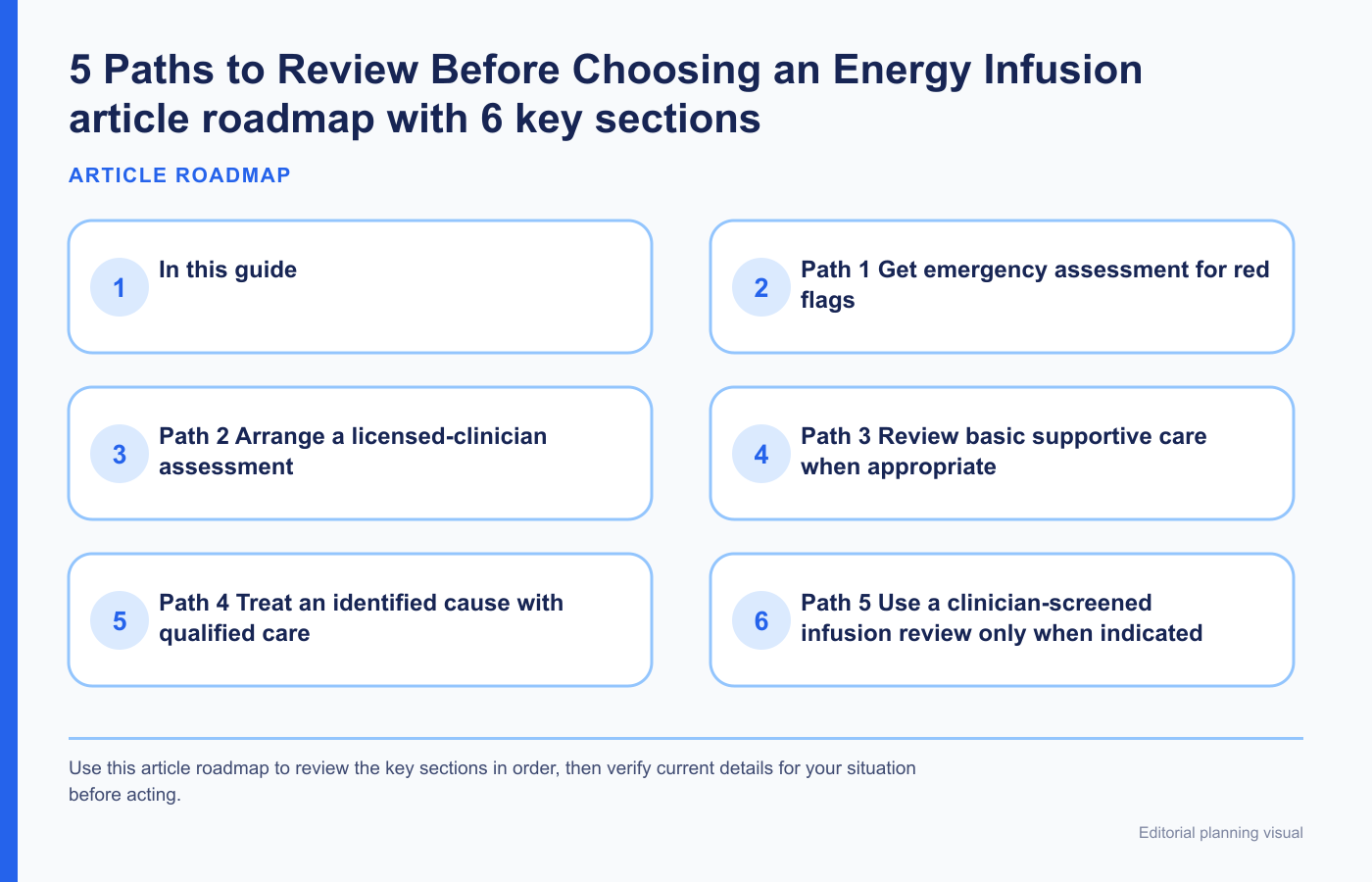
Compare all five low-energy decision paths
| Path | Primary question | Decision owner |
|---|---|---|
| Emergency assessment | Are severe or sudden red flags present? | Emergency services and clinicians |
| Clinical assessment | What could explain the symptom? | Appropriately licensed clinician |
| Basic support | Are non-IV measures suitable and safe? | Individual with clinician guidance as needed |
| Cause-specific care | What treatment addresses an identified cause? | Treating licensed clinician |
| Infusion review | Is a specific authorized IV plan indicated and safe? | Authorized prescriber and administering clinician |
No path promises an energy increase. The correct next step depends on symptoms, history, examination, evidence and applicable professional scope.
Understand IV risks and stop conditions
Potential IV-related harms can include pain, bruising, bleeding, infiltration, vein irritation, infection, allergic reaction, medication or nutrient interaction, dosing or product error, fluid or electrolyte problems and delayed diagnosis of an underlying condition. Individual risk can be higher with particular health conditions or medications.
Health Canada warns that unauthorized injectable products have not been assessed for safety, effectiveness and quality and can pose serious risks. Ask how each product is authorized and sourced. Do not proceed with an unidentified, unlabelled or unverifiable product.
Stop before or during a service for new concerning symptoms, a changed health history, incomplete consent, inability to verify the clinician or product, broken sterile process, unclear emergency capability or pressure to proceed. Seek urgent or emergency care for severe symptoms.
Common energy infusion mistakes to avoid
- Treating low energy as a diagnosis or a nutrient deficiency
- Choosing a branded blend before medical assessment
- Assuming IV delivery is more effective or safer than an appropriate oral route
- Failing to disclose medications, supplements, pregnancy, allergies or health conditions
- Relying on testimonials, before-and-after language or a “natural” label
- Not verifying the clinician, prescriber, product and emergency plan
- Proceeding without written ingredients, risks, alternatives, total price and aftercare
- Using an elective service for emergency or worsening symptoms
Frequently asked questions
Does an energy infusion reliably improve fatigue?
This article makes no efficacy claim. Fatigue has many causes, and a licensed clinician should assess persistent or unexplained symptoms before any treatment decision.
Is an IV better than food, fluids or oral supplements?
Not automatically. The appropriate route depends on an identified need, evidence, ability to take oral intake, health conditions and clinical judgment.
What should I ask about IV ingredients?
Ask for every ingredient, amount, source, authorization status, intended reason, evidence, risks, interactions and alternatives before consent. Do not proceed if answers are unclear.
How can I check a Nova Scotia nurse’s licence?
Use the current Nova Scotia College of Nursing public verification process and match the person’s name and designation. Also ask who assesses, prescribes and supervises the service.
When should low energy be treated as an emergency?
Call 911 or local emergency services for severe or sudden symptoms such as breathing trouble, persistent chest pressure or pain, new confusion, difficulty waking or pale, grey or blue skin.