How to Choose an IV Drip With Clinical Screening
Use this safety-first process to assess an IV drip provider, clinical screening, formulation, product source, consent, monitoring and stop conditions.
By Pure Drip

How to Choose an IV Drip With Clinical Screening
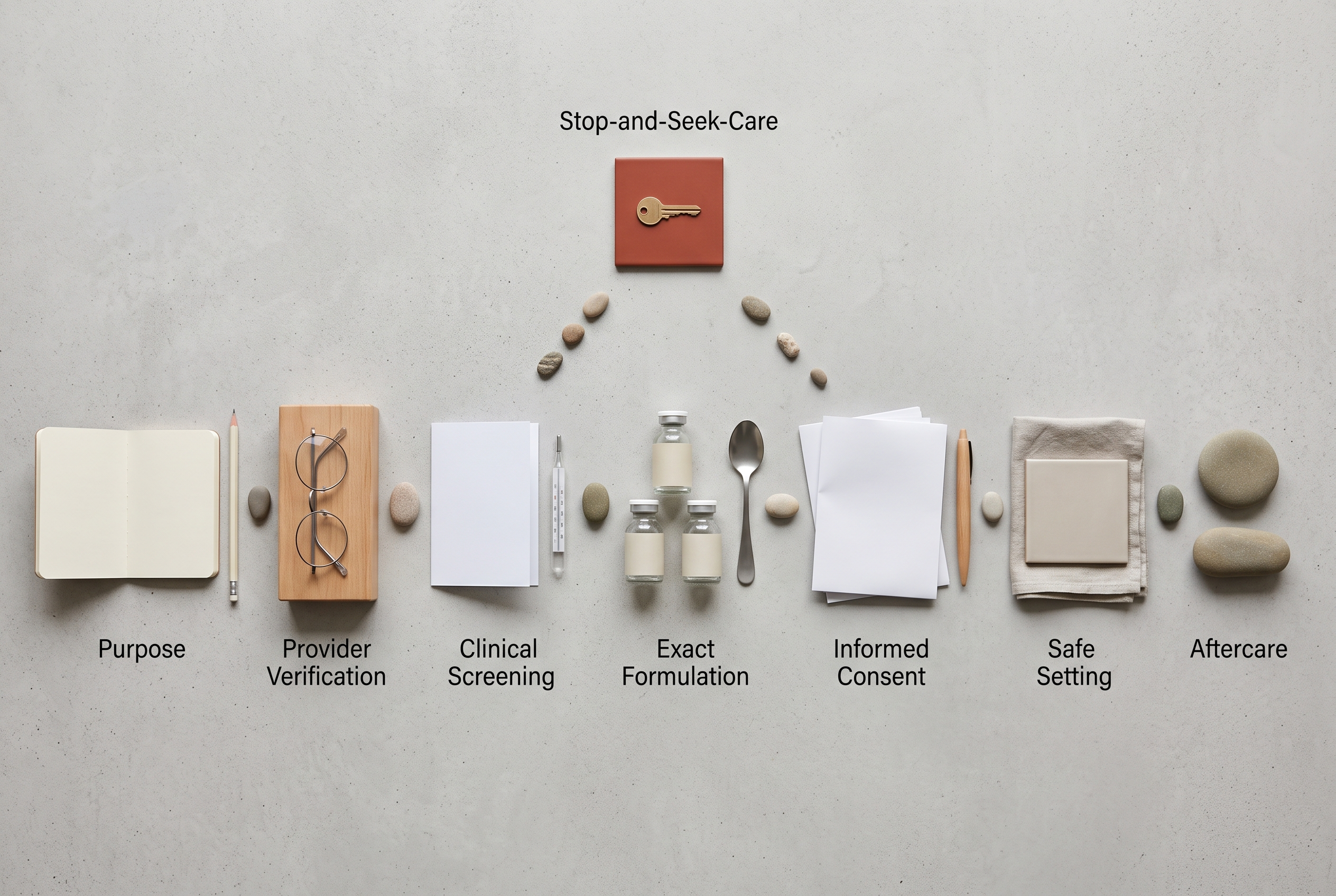
An IV menu can make the choice look simple: select a goal, choose a formula and book. That skips the most important question—whether an elective infusion and its exact contents are appropriate for you at all. A responsible choice starts with clinical screening, a verified professional and a product you can identify, not a benefit-sounding name.
Pure Drip’s current website presents mobile IV therapy in Halifax and surrounding areas and links to service, IV therapy, FAQ and location information. That is useful inquiry context, but it does not independently prove a clinician’s current registration, medical-order process, product authorization, individual suitability or expected result. Confirm each of those items for the actual appointment.
Step 1 — Start with the reason, not the drip name
Write down the problem you are trying to solve in plain language. “I have been vomiting and cannot keep fluids down” is different from “I want a wellness appointment.” New, severe, unexplained or worsening symptoms should not be converted into a spa-style purchase decision. Seek appropriate medical assessment, urgent care or emergency help based on the symptoms and local advice.
Ask what evidence supports the proposed use and what non-IV alternatives exist. For many people, rest, food, oral fluids, a pharmacist conversation or an appointment with their usual clinician may be more appropriate. That is not a universal conclusion; it is the comparison a clinician should help you make. If anyone guarantees a result, diagnoses from a marketing questionnaire or says an infusion replaces medical evaluation, stop.
Step 2 — Verify the person responsible for your care
Ask for the full name and regulated profession of the person who will screen you, authorize or obtain an order for the infusion, start it, monitor it and respond to a complication. Those roles may be held by different people. Check current registration and any publicly listed restrictions in the applicable regulator’s directory; do not rely only on a first name, uniform, social profile or website badge.
- Who reviews the health history and decides whether to proceed?
- What legal order or prescribing process applies to this exact formulation?
- Who is available if the treating professional needs clinical support?
- What happens if screening shows the appointment should not continue?
- How are records, privacy, consent and adverse events handled?
Mobile service adds logistics. Confirm the setting where treatment can occur, how privacy and cleanliness are protected, what emergency equipment is present and how a clinician would call for help. A convenient location is not a substitute for a safe clinical environment.
Step 3 — Complete screening before customizing anything
Customization should follow screening. Bring an accurate list of medications, non-prescription drugs, vitamins, herbal products, allergies and previous reactions. Disclose pregnancy or breastfeeding, kidney or heart conditions, fluid restrictions, blood pressure concerns, diabetes, bleeding or clotting issues, immune concerns, recent illness and any other condition the clinician asks about. Do not omit information because an ingredient sounds natural.
Health Canada’s medication-safety guidance emphasizes that all medications carry risks and tells patients to share their health history and ask about interactions. The practical lesson is simple: a goal such as “energy” does not determine a safe formulation. Screening may lead to a different plan, a referral or no infusion.
| Screening field | What a useful answer should establish |
|---|---|
| Current symptoms | Whether elective service is appropriate or medical assessment is needed |
| Health conditions | Potential fluid, ingredient, monitoring or setting concerns |
| Medicines and supplements | Possible duplication, interaction or contraindication questions |
| Previous reactions | Allergy, infusion or access concerns and emergency planning |
| Clinical objective | A specific, realistic purpose and how success or failure would be assessed |
Step 4 — Identify every ingredient and its source
Before consent, request the exact ingredient name, concentration, total fluid volume, intended route, proposed rate and reason for inclusion. Ask to see the product label where appropriate. Confirm the manufacturer, pharmacy or supplier, lot and expiry, storage process and authorization status, including the Drug Identification Number when one applies. Do not accept an unnamed “blend” as sufficient information.
Health Canada has warned that unauthorized vitamins, minerals and amino acids intended for injection or infusion may pose serious risks, with contamination especially concerning for infused products. A separate Health Canada notice advises consumers to obtain prescription drugs from licensed pharmacies and explains that authorized drugs carry an eight-digit DIN on the label. These notices do not say anything about Pure Drip’s inventory; they explain why product verification belongs in the decision.
Step 5 — Review benefits, risks, alternatives and cost
Informed consent is more than signing a tablet. You should understand the proposed purpose, quality of evidence, meaningful risks, alternatives—including doing nothing—and who to contact afterward. Ask about potential pain, bruising, infection, infiltration, vein irritation, fluid or electrolyte concerns, allergic reactions and risks specific to each ingredient and your health history. The treating professional must explain what applies to you.
Also confirm the full fee, what happens if screening makes you ineligible, cancellation or travel charges, what follow-up is included and whether any laboratory or medical consultation is separate. Cost transparency matters because pressure to “use the appointment” should never override a clinical stop decision.
Step 6 — Check the treatment and emergency setting
Look for hand hygiene, clean preparation, single-use supplies, intact packaging, appropriate sharps disposal and identity checks that match you to the intended products. The professional should remain able to observe you, assess the access site and respond to symptoms. Ask what emergency supplies are available, who calls emergency services and how your location is communicated.
Pure Drip’s IV therapy page and FAQ are sensible places to compare current first-party information before contacting the business. Use the location page to verify the current service context. Treat the answers as a starting point, then confirm the actual clinician, product and protocol for your booking.
Step 7 — Monitor, speak up and know the next action
Tell the clinician immediately about pain, burning, swelling, leaking, numbness, rash, itching, dizziness, nausea, shortness of breath, chest symptoms or any sudden change. Do not try to be polite or “push through.” The clinician should assess whether to slow, stop, remove access, provide care or call emergency services. Severe symptoms require emergency action.
Before the professional leaves, ask what is expected, what is not, how long to monitor the site, whom to contact and how to report a suspected adverse reaction. Keep the provider, product and lot information. Do not schedule another infusion automatically because the first appointment was uneventful; reassess the purpose, response and risk each time.
Common mistakes that weaken the decision
- Choosing a formula from social media, colour, celebrity use or an ingredient trend.
- Assuming “vitamin,” “natural,” “wellness” or “custom” means risk-free.
- Booking before disclosing medicines, supplements, conditions and prior reactions.
- Accepting a business claim as proof of an individual clinician’s registration.
- Proceeding without a clear product label, source or authorization answer.
- Confusing a consent form with an actual consent conversation.
- Ignoring new symptoms because the appointment is already paid for.
- Using an elective infusion as a replacement for diagnosis or urgent care.
Frequently asked questions
Which IV drip is best for fatigue or low energy?
There is no universally best formula, and fatigue can have many causes. A marketing category cannot diagnose the cause or establish that IV therapy is appropriate. Discuss persistent, severe or unexplained fatigue with an appropriate health professional before choosing an elective infusion.
Does a customized IV mean it is safer for me?
No. “Customized” describes selection, not safety. Safety depends on accurate screening, a justified formulation, verified products, lawful clinical authorization, sterile handling, monitoring and your individual circumstances.
How can I check whether an injectable product is authorized?
Ask for the exact label and DIN where applicable, then use Health Canada’s official resources or ask a pharmacist or treating professional. Do not treat a DIN question as the only check because the product, preparation and route all matter.
Can I choose the ingredients myself?
You can discuss your goals and preferences, but ingredient and dose decisions require clinical assessment and appropriate authorization. A provider should not let a menu selection replace that responsibility.
Prepare a decision-ready inquiry
Write down your purpose, symptoms, medical conditions, allergies, medicines, supplements and questions. Then ask for the professional’s name, screening process, exact formulation, product source, consent details, fee and emergency plan. A responsible answer may be “not today” or “see your usual clinician first.” That is a safety outcome, not a failed booking.
Sources reviewed
- Pure Drip website, IV therapy, services, FAQ and location routes — first-party inquiry context only.
- Health Canada medication safety — general risk, history and interaction guidance.
- Health Canada unauthorized injectable and infusion product advisory — product authorization and contamination warning.
- Health Canada unauthorized injectable peptide notice — licensed-pharmacy and DIN verification guidance.